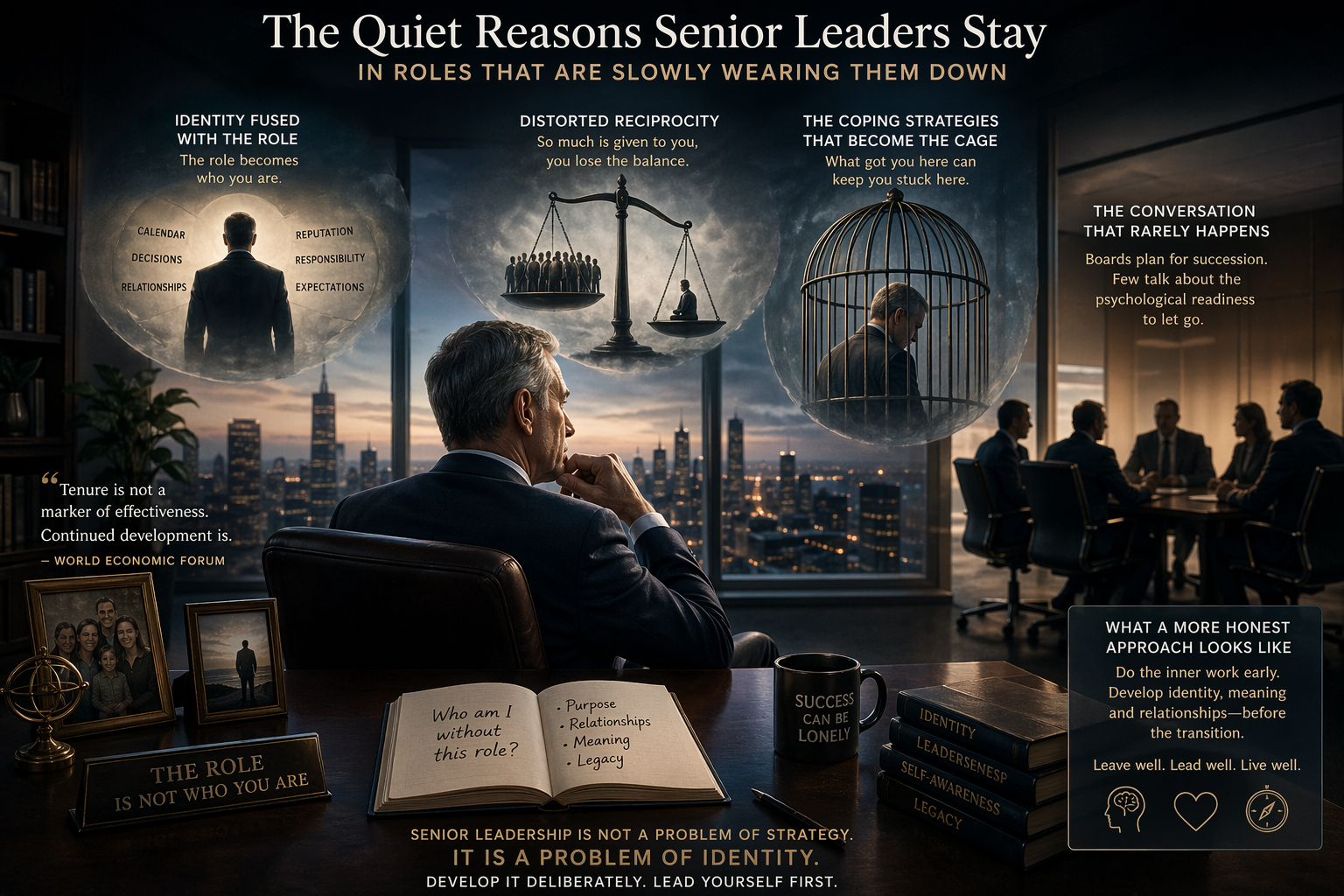
From the outside, a senior executive role looks like a destination. The compensation, the title, the corner office, the public recognition. Few people who have not occupied such a role question why someone would stay in it, even when the cost becomes visible. Internally, the picture is almost always more complicated.
Many of the most senior leaders in European business stay too long in roles that no longer serve them — not because they are oblivious, and not because they are addicted to status, but because of a quieter set of psychological reasons that almost never get discussed in public. Understanding those reasons matters, both for the leaders themselves and for the boards that govern them.
Identity Has Become Indistinguishable from Role
The first and most powerful reason is that, after years in a senior role, the leader’s sense of self has gradually fused with the position. The role is not what they do; it is who they are. The morning routine, the calendar, the relationships, the language used at home, the questions asked at the dinner table — all of it has organised around being the chief executive, the founder, the chair.
Stepping away from such a role is not, in subjective experience, a career transition. It is closer to an identity crisis. The leader who would never admit this in public will, in private, describe the prospect of leaving in language closer to mourning than to retirement. That subterranean reality is the single biggest reason capable leaders overstay.
Reciprocity Has Become Distorted
A second pattern is the slow distortion of reciprocity. In healthy professional relationships, give and take stays roughly balanced over time. At the top of large organisations, that balance gradually tilts. Hundreds of people give the leader something — attention, deference, support, expertise. The leader, even with the best intentions, cannot reciprocate in kind. Over time, this asymmetry erodes the leader’s capacity to receive honest feedback or to feel genuinely connected to the people around them.
The leader does not notice this happening. What they notice is a vague sense that nothing in their professional life feels real anymore — that interactions are scripted, that praise is hollow, that pushback is muted. Many senior executives describe this as loneliness. It is more accurately described as a relational asymmetry that the leader’s role itself has produced.
The Coping Strategies That Built the Career Are Now the Cage
The third reason is more uncomfortable. The very psychological strategies that produced the leader’s success — the relentless drive, the high tolerance for pressure, the ability to compartmentalise, the comfort with being the strongest person in the room — were originally protective. They formed in response to early experience and were refined through career. They worked. They produced results. They got the leader to the top.
At a certain point, those same strategies become the cage. The drive that powered the climb now prevents rest. The compartmentalisation that protected against overwhelm now blocks intimacy. The need to be the strongest in the room now stops the leader from asking for help. The leader cannot easily dismantle these patterns because they were the foundation of everything they have built.
This is the territory in which substantive executive coaching does its most important work. Practices like true-leadership.com — see true-leadership.com — exist precisely to give senior leaders a relationship in which these patterns can be safely surfaced, examined, and slowly rewired. The work is rarely fast. It is also, for the leaders who undertake it, often the most consequential professional relationship they will ever have.
The Boardroom Conversation That Almost Never Happens
In well-governed organisations, succession is treated as a structural issue: timelines, candidates, contingencies. Rarely does the conversation address the psychological readiness of the incumbent to step away. Boards are typically reluctant to broach the subject, partly out of respect, partly because they sense how raw the territory is.
The result is that highly capable leaders often stay six months, a year, or several years longer than would serve either themselves or the organisation. The decision to leave is then forced — by health, by board pressure, by personal crisis — rather than chosen from a position of agency.
The World Economic Forum’s analysis of CEO tenure suggests that the most successful long-tenure leaders are those who deliberately develop themselves throughout the role — not those who simply hold on the longest. The distinction matters. Tenure is not, in itself, a marker of effectiveness. Continued psychological development is.
What a More Honest Approach Looks Like
A more honest approach to senior leadership transitions begins, paradoxically, before the leader is anywhere near leaving. It begins with the leader doing the underlying psychological work while still in role: examining how their identity has fused with the position, what they would have to face if they were no longer in it, what relationships and meanings would need to be rebuilt elsewhere.
Leaders who do this work tend to leave well — at the right time, on their own terms, with their reputation and effectiveness intact. Leaders who avoid this work tend to overstay, regardless of how strategically aware they are about everything else. Senior leadership is not, in the end, a problem of strategy. It is a problem of identity. And identity is something the most effective leaders learn to develop deliberately, long before the question of leaving ever appears on a board agenda.