Tech
Top 8 Critical Copper Machining Pitfalls and How Precision Engineering Insights Save 20% in Costs


Introduction
In the high-pressure world of manufacturing, engineers who procure precision copper partsfor automotive, aerospace, and high frequency electronics applications face an ongoing conundrum. As demand increases for advanced, highly conductive parts, engineers must contend with accelerated tool wear, fast work hardening, and unreliable yield rates, often resulting in increased costs and project delays.
At the heart of this issue is the use of overly automated algorithmic quoting toolsthat do not properly account for the special tooling, precise temperature control, and adaptive process controls required for the manufacture of high-performing copper parts. In this article, we bring you a comprehensive guide in our Manufacturing Solutions Deep Dive series, offering insights into Precision Engineering and showing how you can save as much as 20% on total costs.
Why Do Instant Quotes from Protolabs or Xometry Occasionally Miss the Cost Implications of Copper Milling?
Instant quoting systems are very efficient when dealing with predictable materials but have fundamental limitations with unpredictable materials such as copper, which is soft, ductile, and adheres. These instant quoting systems produce overly optimistic quotes by ignoring the importance of adhesion and the requirements for special machining and toolingneeded in milling copper.
1. The Algorithm’s Oversight of Material Adhesion and Its Effects
Protolabs and Xometry, among others, utilize generalized databases for CNC Cost Factors Analysis. Copper challenges these generalized databases because there are no speed, feed, or tool life predictions for its milling. Copper tends to adhere to the tool, forming what is known as a build-up edge. This changes the effective radius of the tool causing poor surface finish, increased flank wear rate, and tool fracture. The algorithm fails to take into account the need for high pressure coolant in breaking down the bond between the material and the tool, and the need for tool geometries with high polished edges and specified rake angles.
2. Cascading Additional Costs: From Tooling to Secondary/Tertiary Operations
“Low” pricing estimates account for carbide end mills that can be destroyed almost instantaneously on pure copper. The reality lies in the need for additional tooling, including diamond-like carbon coated end mills, along with manual deburring due to the softness of the gummy copper chips. Moreover, reaching an oxide-free state may require special cleaning and passivation procedures after machining. These secondary and tertiary procedurescan drive up the price by 15-25% without being considered in an automated price calculation based solely on geometry.
3. The Essential Role Played By DFM Audits Done By Humans
True Precision Engineering Insight begins with a human-driven design for manufacturability auditprocess. In the hands of an engineer, it may uncover the presence of a deep pocket causing chip evacuation problems with pure copper, or the advisability of using another grade, such as free machining tellurium copper, C14500, instead of pure copper C11000, where critical performance criteria are not involved. This crucial step of DFM engineering based on standards like ASME Y14.5cannot be done by any algorithmic procedure.
What Role do Copper Alloys Decoded Strategies Play in Increasing CNC Milling Efficiency?
Selection of the appropriate copper alloy is the first and foremost factor determining machining performance. Assuming that any “copper” can be treated equally will result in a very inefficient operation. A Copper Alloys Decoded strategybased on correlation between an alloy’s machinability rating and its functional/shape requirements will help achieve high CNC Milling Efficiency, superb surface finish, and predictable tool life.
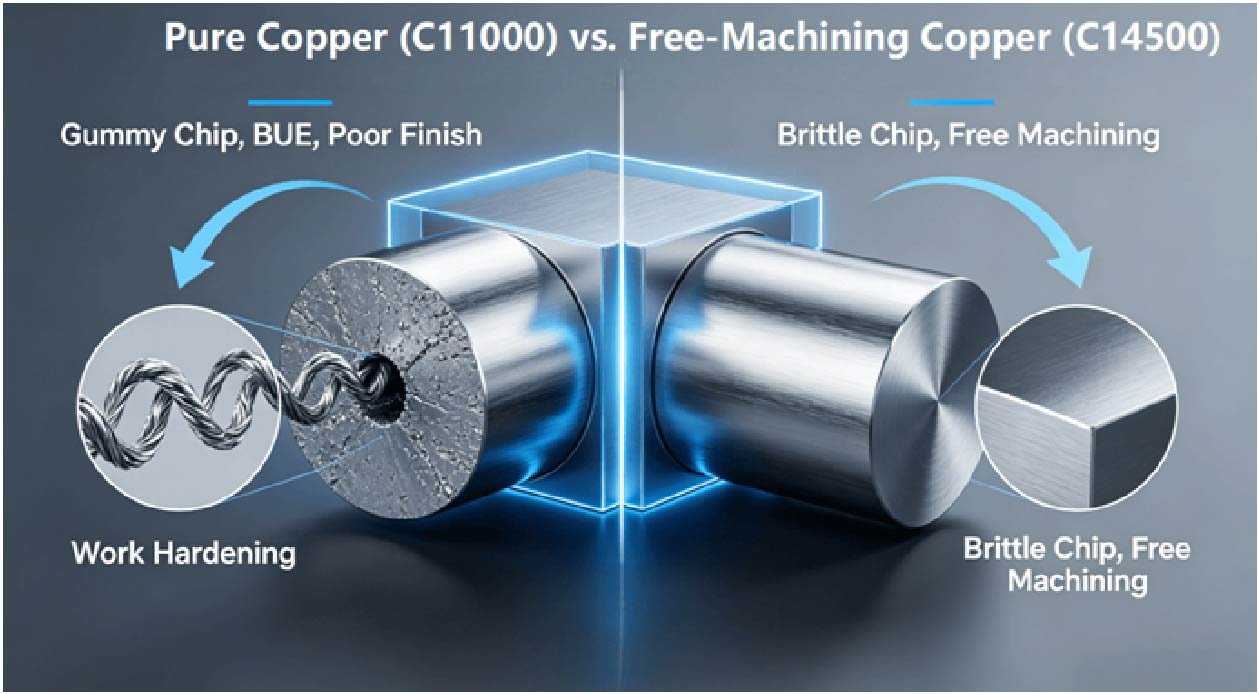
1. Moving Along the Machinability Scale: from Highly Ductile Pure Copper to Designed Alloys
On one side, ductility of pure copper (C11000)makes this metal prone to produce long and curly chips, damaging surface finish. On the other hand, tellurium copper (C14500), as well as leaded brass (C36000), have additives, making their chips short, discontinuous, and contributing to much faster machining. This knowledge gives engineers the ability to make an important decision, which consists in trading off a somewhat lower conductivity of such alloys for a substantially higher material removal rateand tool life.
2. Process Optimization: Feeds, Speeds, and the Art of Controlling Chips
The problem with gummy materials is that the incorrect settings lead to work hardening, resulting in a hard glass-like layer that prevents further operations. It can be solved by setting higher surface speeds, which create enough heat to soften the material before the cut, together with using slower feeds. High-end suppliers implement either trochoidal milling or dynamic tool paths, which provide constant engagement of the cutting edge and ensure the heat is not created while allowing efficient chip removal.
3. The Crucial Balancing Act: Conductivity, Strength, and Machinability
While beryllium copper provides great strength properties, it raises the price, is difficult to machine (because of dust) and needs coating. A perfect alternative for RF connectors and busbars would be a highly conductive, free-machining version of beryllium copper, such as C14500 grade with >90% IACS conductivity. This is because of an extensive study of this material’s microstructure and the knowledge it allows for rapid machiningwithout any stops.
Is Your Selected Copper Milling Supplier Able to Fulfill IATF 16949 High Quality Requirements?
In situations where a malfunctioning connector can stop the production process, control is important. Certifications such as IATF 16949 (automotive)and AS9100D (aerospace) are more than just seals. They are objective proof that a supplier has the institutionalized ability to deal with copper’s variability using preventative techniques rather than inspections.
1. IATF 16949: Tool for Process Prediction and Control
In order to satisfy the requirements of the IATF 16949 standard, a copper milling manufacturer needs to use statistical process control (SPC). It is especially important because for copper, the rate of tool wear is non-linear and thermals induce the drift. For a process that involves machining, it is necessary to carry out process capability analysis (Cpk) that would show that the process is able to make several batches of custom parts before the mass production begins.
2. AS9100D: The Ultimate Standard for Traceability and Mitigation
The AS9100D standard brings a new requirement for stringent material traceabilityand verification through First Article Inspection (FAI). The metal blanks require a connection to the corresponding mill certificate, while all parts produced by the first article require verification according to the 3D model. Through this precise engineering insight, every defect in a critical aircraft part will be tracked back to the source, providing a reliable traceability chain unavailable to general-purpose machine shops.
3. Preventive Culture within FMEA
The essence of these standards lies in preventive risk management through Failure Mode and Effects Analysis (FMEA). When an authorized manufacturing company finds its tool failing, it does not take corrective action alone but recognizes beforehand the risk associated with the large coefficient of thermal expansion of copper on the tolerance of bores. To prevent this from happening, manufacturers ensure that the machining process takes place under controlled temperatures and probe testing during the process for thermal compensation.
What Are the Important Cost Drivers for Copper CNC Milling Services?
H2: Having an awareness of the real drivers of cost involved in copper CNC milling services is one of the first steps to take in achieving budget control and supplier intelligence. Moving past simplistic ideas such as “machine time” will show where money needs to be spent and which suppliers can offer expertise.
- Tools: The Main Variable Cost: Copper tends to be abrasive, while adhesion causes quicker wear of tools. While carbide tools are necessary in working with copper, the life of a tool when machining copper can only be expected to last 30-50% as long as machining steel. Expert suppliers monitor the lifespan of their tools by use of sophisticated computer programs linked to the data coming in from the machinery, thus allowing for timely tool replacementwithout any losses of production due to tool failure.
- The Significant Burden of Secondary Operations: Copper components are frequently quite soft and prone to sticking together during the manufacturing process, so manual deburringis unavoidable. Besides, any residue of cutting fluid must be removed as it can facilitate the oxidation process. This requires special cleaning procedures. The non-machining, value-added operations are very important for the production of premium parts and can represent as much 15-20% of the total costs. A trustworthy supplier always lists them separately; an excessively low quote most likely conceals them by means of barely acceptable profit margins, thus giving opportunity for cost-cutting at the expense of quality and potential post-bid modifications.
- The True Cost of Non-Conformance: Scrap, Delay, and Reputation: Just because a supplier has the lowest price on copper parts does not necessarily mean that they are economical. You will barely get the savings from additional expenses like rework, shipment delays, and machine downtimes caused by the quality issues. A well-documented source for copper CNC milling services mentions that one of the best ways to minimize the risks is to partner with a trustworthy supplierwho has a proper quality management system in place. Such supplier will provide you with a lower rate of scrap and a higher percentage of on-time deliveries which in turn, will reduce the Total Cost of Ownership (TCO).
Why Do I Need a Local Partner in Search of Metal Milling Services Near Me?
While international online platforms provide unparalleled convenience for standard components, the nature of copper, its sensitivity to processing factors, and its requirement for continuous improvements create a significant advantage in terms of location and cooperation. The importance of a local metal milling services near meservice provider goes well beyond logistics.
1. Shortening Prototype Development via Instant Collaboration
The process of copper prototype fabricationrequires multiple iterations. What looks promising at the simulation stage can prove problematic when actually applied. Thanks to a local partner, an engineer can arrive at the facility in a few hours, examine the first sample, talk about chip characteristics with the operator, and give his approval to modify the parameter within minutes. The time between iterations decreases from several weeks to just a few days, compared to days-long delivery and asynchronous correspondence associated with distance-based platforms such as Hubs or Fictiv.
2. Mitigation of Supply Chain Risk for a Valuable Commodity
Copper is costly raw material. Shipping fragile prototypes over long distances can be one of the reasons they are broken. One of the advantages of getting materials from local sources is that you get rid of the transport difficulties and eventually you save on freight costs and product lost and product oxidation due to the travel is also minimized to a great extent. Besides, certificates and provenance become more straightforward to trace owing to the shorter supply chaininvolved. Such a level of control is a critical yet frequently ignored aspect of using one’s development risk for the program.
3. Benefit of Industry-Specific Expertise
An experienced local specialist understands which material suppliers are popular in the region, what manufacturing best practices exist within their industry, and where other companies encounter typical problems. They can function as an extension of your development departmentand provide you with direct and relevant DFM guidance. In essence, it might consist of pointing out locally available alternative alloy materials instead of waiting for a month-long lead time for your copper machining.
What Makes a First-Rate Manufacturer Capable of Delivering Zero-Defect Copper Milling on a Global Scale?
A perfect faultless precision copper milling in large quantities is basically the combination of new technologies, top-notch quality management practices, and materials science rather than just the result of a single computer. It takes a comprehensive method to control and optimize all parameters for the delivery of the same.
1. Process-Oriented Approach: Science Instead of Art
The starting point is a thorough review of material science, when an alloy that should be used along with its ideal temper and microstructure is selected. Then the machining process itself is designed based on fundamental principles: high pressure and cold tool coolant are applied to reduce heat generated during the process, while simulations are conducted to compensate for springback and thermal distortionahead of time. This eliminates work hardening.
2. Digital Execution and Seamless Traceability
Utilizing a certification-based platform that includes AS9100D and ISO 9001, the most advanced manufacturers operate within a full digital thread ecosystem. All custom copper milling operations adhere to a digital work instruction, supported by real-time SPC charts to track critical parameters. Each part has traceability back to the material certification, machine logs, and comprehensive first article inspection reports (usually a color-coded 3D deviation map). This guarantees customers the necessary precision engineering insightsand documentation for regulatory and supply chain requirements.
3. The Power of Scale and Flexibility
The best suppliers can harness the combined strengths of a global supplier and a local expert. They control both custom copper prototyping and mass production within cell manufacturing, adhering to NIST smart manufacturingguidelines. Through data analysis collected from machine sensors that help anticipate tool degradation and process shifts, they shift from reactive scheduled maintenance to proactive condition-based maintenance, ensuring that their deliveries are on time for more than 99.8% of mission-critical parts.
Conclusion
Choosing an outsourcing partner for your precision copper components is not only a strategic move but is much more than just sourcing. Rather than falling prey to the temptation of algorithmic quotations generated almost instantly, adopting an approach that relies on a comprehensive understanding of alloy mechanics and process drivers, and sticking to the highest standards such as IATF 16949 and AS9100D will ensure you dodge costly mistakes that lead to 20%+ overruns of your traditional manufacturing projects. Your way forward lies through precision engineering insightsand cooperation with professionals that put that vision into practical use in manufacturing.
FAQs
Q: What causes delays in shipping orders for copper parts purchased from massive online networks?
A:The causes relate to improper process application. Specialized processes are required due to the special characteristics of copper, which most of the network subcontractors lack. As a result, significant amounts of waste occur due to work hardening and tool wear, leading to the need for rework not accounted for by the quoting system.
Q: What is the best alloy for fast turn prototyping of copper parts?
A:Tellurium copper (C14500) is recommended for functional prototypes as the best material choice. It offers a nice tradeoff between high machinability (small fragmented chips) and good electrical conductivity (more than 90% of IACS), allowing you to machine it at increased speeds and obtain consistent results.
Q: What measures can be taken to prevent surface oxidation in copper parts machined using CNC?
A:To prevent surface oxidation, it is important to have proper process control. Thus, you should check that your supplier is using oxidation inhibitors in their coolant and also has a properly designed cleaning line. Immediate post-cleaning passivation or protective packaging is the best way to keep parts from oxidizing.
Q: IATF 16949 certification for precision copper parts, why is it a point of discussion?
A:This standard promotes the implementation of advanced quality management tools like FMEA and SPC, among others. With copper, for example, that would mean understanding the risks, such as thermal distortion or wear variability, without waiting for the problem to manifest. This provides the statistical evidence of process capability (Cpk) that is required, especially when the product is expensive and produced in large quantities.
Q: How can you minimize the costs of machining copper parts?
A:The most effective approach is the early involvement of DFM. Internal simplification of the design, realistic tolerance requirements as defined by ASME Y14.5 standards, and the choice of free-cutting copper alloy based on P.E.I. Review analysis will help cut machining time and minimize machining and secondary operations costs by 20-30%.
H3: Author Bio
The author is an expert in precision engineering from LS Manufacturing, which is a company that provides critical custom-made copper components for industries like the aerospace industry, the healthcare sector, and electric vehicles. This company follows a methodology based on principles, including those of IATF 16949 and AS9100D, to convert difficult geometries and materials into optimized solutions through manufacturing. If you would like to get a free DFM analysis for your copper component, contact them with project details.


Best Portable Monitors for Gaming on the Go in 2026

Breastfeeding Challenges: What Parents Should Know About Tongue-Tie and Lip-Tie

My First Miami Boat Party: What I Wish I Knew Before Hitting the Water

How to Reduce Office Printing Costs Without Sacrificing Quality

How Does Same-Day Delivery Work for UK Businesses?

Debraca Denise: Inside the Life of Redd Foxx’s Daughter

Rachel Catudal: Brandon Quinn’s Wife, Career, Family and Life

Who Is Catherine Hawn? The Life of Dean Martin’s Former Wife

Who Is Will Theron Roth? The Private Life of Laurie Metcalf and Matt Roth’s Son

Brandy Quaid: What to Know About Randy and Dennis Quaid’s Family

Fabswimger: Legit Platform or Something Else?

Piçada: Linguistic Roots and Modern Usage

Jeroen Dik: JD Engineering & Racing Legacy

Helen Soby: Biography, Age, Net Worth & Life Story

Veb Vatsap Com Explained: Must-Know WhatsApp Web Guide

Pigeimmo: AI Real Estate Lead & Investment Tool

Ronenia: Meaning, Origin, Symbolism, and Creative Guide

Mietmakler: Fees, Laws & Expert Tips Germany

Piragnia Fish: Truth Behind the Piranha Myth